 lop News
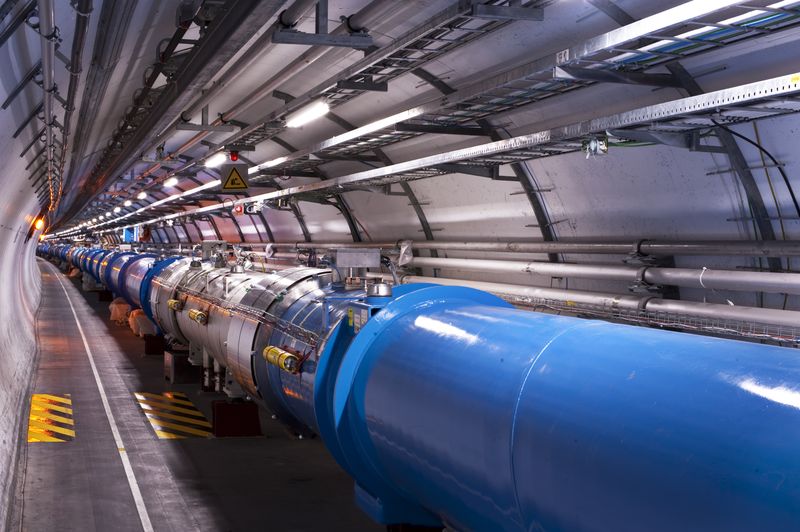
£49.4 million. That was the price of Britain’s seat at the table for one of the most ambitious particle physics experiments of the next decade. On 19 December, researchers learned the money was gone.
The UK has pulled its funding for the second upgrade of the LHCb experiment at CERN’s Large Hadron Collider — a detector that studies the differences between matter and antimatter, one of the deepest unsolved puzzles in physics. The decision, confirmed by Michele Dougherty, executive chair of the Science and Technology Facilities Council, was blunt: “In the short term, we cannot afford to fund the upgrade.”
The timing carries a particular sting. Britain’s claim to the Higgs boson is arguably its greatest scientific achievement of the 21st century. Peter Higgs, the Edinburgh theorist who predicted the particle’s existence in 1964, became a national icon when CERN confirmed the discovery in 2012. He shared the Nobel Prize the following year. British institutions — Oxford, Imperial College London, Edinburgh — were woven through both the theoretical groundwork and the experimental apparatus that made it possible.
Now the country that helped build the machine is walking away from its next chapter.
What’s Being Lost
The LHCb Upgrade II is not a vanity project. The £150 million detector overhaul, with construction slated to begin in 2027 and installation by 2035, would enable a tenfold increase in collision data. Its target: CP violation, the subtle asymmetry between matter and antimatter that may explain why the universe is made of stuff rather than nothing.
The UK’s £49.4 million share — awarded in 2022, with £5 million already spent on pre-construction — amounted to roughly a third of the total budget. Without it, international partners say the project faces potentially fatal consequences.
Tim Gershon, a particle physicist at the University of Warwick and the incoming spokesperson for the LHCb collaboration, did not mince words. “It was a complete shock,” he told Physics World. “It’s like paying to heat your house but then sitting outside in the cold.”
The analogy is apt. Britain will continue paying its annual CERN subscription — the heating bill — while forfeiting the scientific programme that subscription is meant to support. The LHCb collaboration spans over 1,700 physicists across 100 institutions in 22 countries. Four of its eight spokespeople have been British. The UK didn’t just participate in this experiment; it helped lead it.
The £162 Million Hole
The LHCb cut is not an isolated decision. STFC is scrambling to close a cumulative £162 million budget shortfall by 2029/30, driven by rising electricity costs at national facilities, inflation-eroded budgets, and higher CERN and European Space Agency subscription fees. The council’s budget nominally rose from £835 million to £842 million over the period — an increase swallowed entirely by costs it doesn’t control.
The damage extends well beyond CERN. Research grants in particle physics, astronomy, and nuclear physics face cuts of roughly 30 per cent from 2024/25 levels, compounding a 15 per cent reduction already imposed the previous year. UKRI has shelved physics infrastructure projects worth £280 million. The Institute of Physics called the situation a “devastating blow.”
Pulling Up the Ladder
What makes this more than a budget dispute is the pattern it represents. The UK government has directed UKRI to prioritise research that generates economic growth — a reasonable-sounding mandate that, in practice, means fundamental physics loses to applied science in every allocation round.
The irony is that fundamental physics does generate economic returns, just on timescales that don’t fit spending reviews. The previous LHCb upgrade produced £15 million in contracts for over 80 UK companies. Technologies developed for particle detectors have spun off into medical imaging, data science, and computing infrastructure. The World Wide Web was invented at CERN.
But the more immediate cost is human. Senior physicists are internationally mobile; when funding disappears, they leave. Early-career researchers, already squeezed by successive grant cuts, face the prospect of entire departments closing. Mike Lockwood, president of the Royal Astronomical Society, has called the situation “a catastrophe for science” that will deter students from pursuing careers in physics.
Peter Higgs died in April 2024 at the age of 94. Less than two years later, the country that claimed his legacy as a point of national pride is dismantling the infrastructure that made it possible. The ladder is being pulled up. The question is whether anyone in government notices before the climbers are gone.
Sources
- CERN upgrade to LHCb experiment threatened by UK funding cuts — Physics World
- LHCb upgrade: CERN collaboration responds to UK funding cut — Physics World
- Higgs Boson breakthrough was UK triumph, but British physics faces ‘catastrophic’ cuts — BBC News
- Physics at risk: UK science leader on what’s wrong with the latest funding cuts — Nature
- CERN project cut ‘weakens’ UK global standing, says STFC leader — Research Professional News
- U.K. physics community braces for deep funding cuts — Science