 lop News
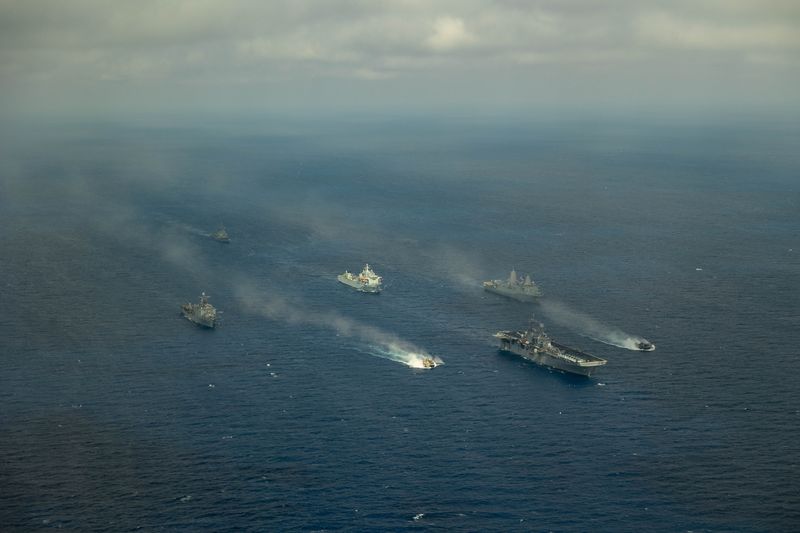
Two Marine Expeditionary Units. Five thousand troops. Three amphibious assault ships built to put boots on beaches. And a president who told reporters on Thursday: “No, I’m not putting troops anywhere.”
The gap between those facts is the story of Operation Epic Fury’s third week.
The Deployment
The Pentagon is sending roughly 5,000 additional Marines and sailors to the Middle East in what amounts to the most significant ground-capable force movement since the operation began on February 28. The 11th Marine Expeditionary Unit, approximately 2,500 Marines based at Camp Pendleton, California, departed San Diego aboard the USS Boxer on Thursday — three weeks ahead of its scheduled deployment. The USS Portland and USS Comstock, both amphibious landing docks, were already at sea off the California coast and will join the group.
Separately, the 31st MEU — normally stationed in Japan — has been ordered to transit to the Middle East, adding another 2,200 Marines to the theater. Defense Secretary Pete Hegseth approved the deployment at the request of U.S. Central Command, which oversees the roughly 50,000 American troops already operating in the region.
The USS Boxer is a Wasp-class amphibious assault ship. It carries F-35B stealth jets capable of vertical takeoff, V-22 Osprey tiltrotors, attack helicopters, and hovercraft in its well deck designed to support amphibious landings. These are not the assets of an air campaign. They are the assets of a force that expects to go ashore.
The Rhetoric
The administration’s messaging has been careful — and increasingly difficult to square with the hardware heading east.
President Trump told reporters Thursday that he was not deploying troops, adding: “We will do whatever is necessary.” A White House official offered a more lawyerly formulation: “There has been no decision to send ground troops at this time, but President Trump wisely keeps all options at his disposal.” Hegseth described the mission as “laser-focused” on destroying Iran’s offensive capabilities.
The phrase “at this time” is doing considerable work in that sentence. So is the distinction between “ground troops” and Marines deployed on amphibious ships within striking distance of the Iranian coastline. MEUs are specifically trained for terrain seizure and coastal raids — they are, by design, ground troops that arrive by sea.
What the Forces Could Do
According to reporting by Reuters and Military Times, Pentagon planners are weighing several options that would require boots on the ground:
Strait of Hormuz security. The waterway handles roughly 20 percent of the world’s daily oil supply. Despite more than 7,800 U.S. strikes and the destruction of over 120 Iranian vessels since February 28, residual Iranian capabilities could still disrupt shipping. Michael Eisenstadt of the Washington Institute for Near East Policy suggested the MEUs would likely conduct raids on Iranian coastal targets around the strait. “It takes so little to disrupt the shipping industry,” he noted.
Kharg Island. Iran’s primary oil export hub, handling 90 percent of the country’s crude shipments. Officials acknowledged that seizing or blockading the island would be “very risky” given Iranian missile and drone capabilities in the area.
Uranium stockpile seizure. Perhaps the most fraught option — securing Iran’s enriched uranium supplies. Officials described this as “highly complex and risky, even for U.S. special operations forces,” though it aligns with Operation Epic Fury’s stated objective of ensuring Iran can never obtain a nuclear weapon.
Retired Marine Colonel Steve Ganyard cautioned that MEUs lack the logistical support for sustained operations ashore, suggesting any ground action would be limited to raids rather than occupation. Analysts at the Center for Strategic and International Studies echoed this, noting that the current force package does not constitute a major ground force.
The Political Math
The deployment puts Trump in a bind of his own making. He campaigned explicitly on avoiding new Middle East entanglements. A Quinnipiac University poll found 74 percent of registered voters oppose sending U.S. ground troops to Iran. Only 20 percent support it.
Three weeks into Operation Epic Fury, American casualties stand at 13 killed and approximately 200 wounded, most injuries described as minor. Those numbers are modest by historical standards — but they belong to an operation the public was told would be conducted from the air and sea.
Every MEU that steams toward the Gulf narrows the distance between air campaign and ground war. The administration may well be right that these forces are intended for force protection, maritime security, or contingency planning rather than invasion. But the hardware tells its own story. Amphibious assault ships are not built for ambiguity.
The question is no longer whether America has the capability to go ashore in Iran. It is whether the logic of this campaign — and the objectives the president has set for it — will make that decision for him.
Sources
- US to deploy thousands of additional troops to the Middle East, officials say — Reuters
- US weighs military reinforcements as Iran war enters possible new phase — Military Times
- US Sends Another 2,500 Marines to Iran as Ground Option Emerges — Military.com
- USS Boxer and 11th Marine Expeditionary Unit deploy to Middle East — Military Times
- US sending 2,500 Marines, at least 3 ships to the Middle East — Stars and Stripes
- Deployment of Marines to Middle East raises specter of ground troops in Iran — ABC News
- US weighs sending thousands of troops to region as Iran war rages — Al Jazeera
- Trump: ‘I’m not putting troops anywhere’ — The Hill