 lop News
Three weeks into the US-Israeli war on Iran, a line has been crossed that few imagined would be tested. On Saturday, Iranian missiles struck the southern Israeli town of Dimona, home to Israel’s principal nuclear research facility. Hours later, a second missile hit the nearby town of Arad.
The symbolism was unmistakable. Earlier that day, Iran’s atomic energy organisation had accused the United States and Israel of striking its Natanz uranium enrichment complex. Now Tehran had answered in kind — not by targeting military bases or government buildings, but by reaching for the most sensitive site in Israel’s strategic arsenal.
Israeli Prime Minister Benjamin Netanyahu called it a “very difficult evening in the battle for our future.” In a statement released after the strikes, he vowed that Israel was “determined to continue striking our enemies on all fronts.” His choice of words — a “battle for our future” — suggested that Israel’s leader understands the conflict has entered new territory.
The Casualties
The human cost was immediate. Israel’s Magen David Adom emergency service said its teams treated 33 people at multiple sites in Dimona, including a 10-year-old boy left in serious condition with shrapnel wounds. A woman in her 30s was moderately injured by glass shards; 31 others sustained minor injuries from shrapnel or falls. Another 14 were treated for acute anxiety.
Hours later, the toll mounted. Paramedics transported 59 patients from Arad to hospitals, according to Magen David Adom — six in serious condition, 13 in moderate condition, and 40 with mild injuries. Israel’s firefighting service described a “direct hit” in Arad’s city centre, between residential buildings, causing “extensive damage.” In total, more than 100 people were wounded across both strikes.
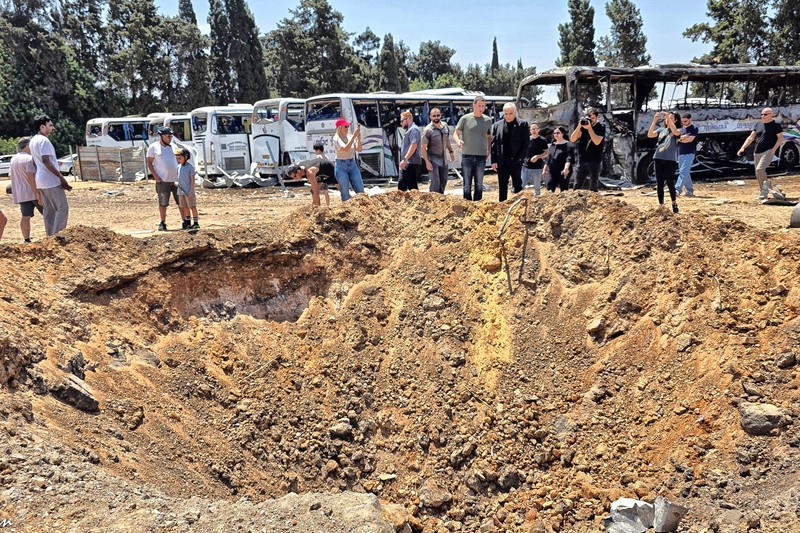
Video footage from Dimona showed a large crater gouged into the ground next to piles of rubble and twisted metal. Surrounding buildings had their windows blown out and facades heavily damaged. One three-storey building collapsed entirely, according to Al Jazeera’s verification of witness footage.
A Nuclear Shadow Box
The desert city of Dimona has been at the heart of Israel’s nuclear programme since its research centre, built in secret with French assistance, opened in 1958. Israel is widely believed to have developed nuclear weapons by the late 1960s. Its official policy is one of deliberate ambiguity — neither confirming nor denying their existence.
The International Atomic Energy Agency said it had received no indication of damage to the Shimon Peres Negev Nuclear Research Center at Dimona itself, and that no abnormal radiation levels had been detected. IAEA Director General Rafael Grossi reiterated his “call for military restraint to avoid any risk of a nuclear accident.”
But the message from Tehran was delivered regardless. Iranian state television called the Dimona strike a “response” to the attack on Natanz. The symmetry was precise: you strike our nuclear infrastructure, we will strike yours.
Israel’s military said it was “not aware of a strike” on Natanz, despite Iran’s atomic energy organisation stating that the US and Israel had targeted the enrichment complex. An unnamed Israeli official quoted by the Associated Press denied Israeli responsibility. But the denials did little to alter the perception in Tehran that its most sensitive facilities were now fair game.
Escalation Without Boundaries
The mutual targeting of nuclear-adjacent sites marks a stark new phase in a conflict that shows no sign of de-escalating. Abas Aslani, a senior fellow at the Centre for Middle East Strategic Studies in Tehran, told Al Jazeera that Iran has been pursuing an “eye-for-an-eye approach” designed to re-establish deterrence.
“Tehran wants to reduce the gap between words and actions,” Aslani said. Iran’s goal, he suggested, was not simply to force a ceasefire but to make its threats credible enough to underpin a new long-term security arrangement.
The strikes on Dimona and Arad exposed the limits of Israel’s much-vaunted air defence systems. The Israeli military said “interception attempts were carried out” after the missiles were detected, but acknowledged that some got through. Firefighters at the scene said interceptors had failed to hit the threats, resulting in “two direct hits by ballistic missiles with warheads weighing hundreds of kilograms.”
An Israeli military spokesman conceded the missiles were not “special or unfamiliar” — suggesting that even conventional Iranian ballistic weapons can penetrate Israeli defences when launched in sufficient numbers.
A War That Keeps Expanding
The nuclear tit-for-tat came on a day when Iran also launched what officials described as its 70th wave of attacks since the war began on February 28. Iranian forces struck energy infrastructure across the Gulf — in Kuwait, Qatar, Saudi Arabia, and the United Arab Emirates — after Israel hit Iran’s offshore South Pars gas field, part of the world’s largest natural gas reserves.
Iran also fired two intermediate-range ballistic missiles at the Diego Garcia US-UK military base in the Indian Ocean, some 4,000 kilometres from Iranian territory. Neither missile struck the base, but the attempt marked Iran’s first use of such long-range weapons in the conflict. Israel’s military chief, Eyal Zamir, said Iran had used a “two-stage intercontinental ballistic missile with a range of 4,000 kilometres” — weapons he noted were “not intended to strike Israel.”
“Their range reaches European capitals,” Zamir added.
The Strait of Hormuz, through which a fifth of global crude trade normally passes, remains choked by Iranian forces. Oil prices have surged past $119 per barrel, up from roughly $70 before the war began. A coalition of European and Gulf states has condemned the “de facto closure” of the waterway and expressed readiness to contribute to efforts ensuring safe passage.
No Exit in Sight
Inside Iran, the death toll has passed 1,500, according to the Iranian health ministry. According to Al Jazeera, the dead include more than 200 children. The country’s leadership has been decapitated — supreme leader Ali Khamenei was killed earlier in the conflict, and his son Mojtaba Khamenei, who succeeded him, has remained out of the public eye.
Yet the regime’s capacity to strike back has proven more durable than Western analysts anticipated. “They’re showing a lot of resilience that we didn’t perhaps expect, that the US didn’t expect, when it took this on,” Neil Quilliam of Chatham House told the think tank’s podcast. The Islamic republic, he noted, has “deep roots.”
For now, both sides appear locked into escalation. Netanyahu’s promise to continue striking Iran “on all fronts” suggests that the Dimona attack will not be the last exchange in this increasingly dangerous conflict. And with both countries’ nuclear facilities now in the crosshairs, the margin for error has narrowed considerably.
The old rules — that certain targets were too dangerous to touch, that nuclear sites existed behind an invisible line — no longer seem to apply. What replaces them remains unclear.
Sources
- Iran strikes Israeli nuclear town in retaliation for Natanz attack amid escalating conflict — France 24
- 🔴 Iranian missile hit town housing nuclear facility, Israeli army says — France 24
- At least 40 injured after Iranian missile strikes Israeli town home to nuclear facility — Euronews
- Iran says Natanz nuclear site was struck, as Tehran launches ballistic missiles at US-UK base — Euronews
- Iran strikes towns near Israel’s nuclear site in escalating tit-for-tat — Al Jazeera
- Iran hits Dimona, Israeli town with nuclear facility, despite air defence interceptors — South China Morning Post