 lop News
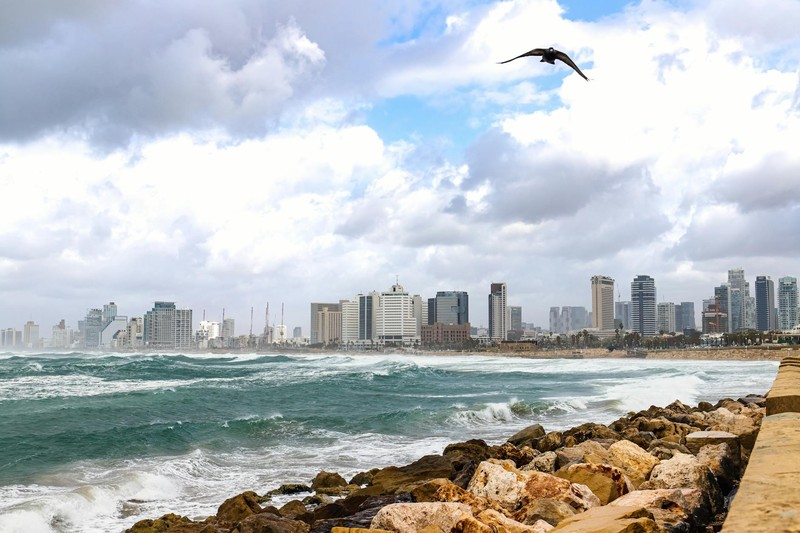
The missile gouged a crater into a Tel Aviv street and shredded the facade of an upscale apartment building. Six people were wounded, two moderately. Cars were crushed. Windows blew out across the neighborhood.
Israel’s air defense systems did not intercept it.
The breach was not an anomaly. As Iran launched wave after wave of missiles at Israel on Tuesday — at least eight separate barrages, according to the Israeli military — projectiles found their way through the vaunted multi-tiered shield that has protected the country for years. Impacts were reported at four sites across Israel. In Tel Aviv, rescue workers searched buildings for trapped civilians.
The psychological mathematics of life under fire is changing: for years, Israelis trusted that the sirens meant time to reach safety while interceptors did their work. Now, the threat arrives regardless.
“It feels like you’re a sitting duck, waiting for the missiles to hit you, or someone next to you,” Amir Hasid told reporters after emerging from a shelter.
The Cluster Bomb Problem
The failure is partly technical. According to The Guardian, at least 19 Iranian ballistic missiles carrying cluster warheads have penetrated Israeli airspace since the war began on February 28, killing at least nine people and wounding dozens. Roughly half of Iran’s missile launches now carry cluster munitions.
Cluster warheads disperse up to 80 smaller bomblets mid-flight, spreading destruction across a wide area. For Israel’s defense systems — Iron Dome, David’s Sling, Arrow — the calculus is brutal: intercept the carrier vehicle before dispersal, or face dozens of targets that are, in the words of missile expert Tal Inbar, “virtually impossible” to stop.
“Intercepting cluster munitions is fundamentally more difficult than stopping unitary missiles,” said Inbar, who consults for Israeli defense companies. Even a successful intercept before dispersal may not neutralize all the submunitions.
Iran appears to have calculated that cluster weapons accomplish two goals: they slip payloads through the shield, and they drain interceptor stocks. Israel’s stockpile numbers remain classified, but speculation is mounting that supplies are under strain.
The result is visible in the skies over greater Tel Aviv. Videos circulating since early March show cluster munitions descending as dozens of bright points of light — the new visual shorthand of this war for Israeli civilians.
The Coordination Endures
The attacks demonstrate what FRANCE 24’s Noga Tarnopolsky, reporting from Jerusalem, called evidence that “Hezbollah and Iran are still able to coordinate strikes” — a troubling signal for Israeli war planners who assumed that a month of sustained bombardment would degrade that capacity.
Israel’s military says it has destroyed more than 70 percent of Iran’s ballistic missile launchers and achieved near-total control over Iranian airspace. Yet Tehran still breaches Israel’s skies. On the Lebanese front, Israel’s defense minister announced Tuesday that troops would seize a buffer zone up to the Litani River — roughly 30 kilometers into Lebanon — and that displaced residents would not be allowed to return “until security is guaranteed for the residents of the north” of Israel.
“The principle is clear,” Defense Minister Israel Katz said. “There is terror and missiles, no homes and no residents — and the IDF is inside.”
The Lebanese government, which has vowed to disarm Hezbollah, denounced the plan as “collective punishment against civilians.” More than 1,000 people have been killed in Lebanon since the latest escalation began, including at least 118 children. Over a million are displaced.
A War on Two Fronts
Israel is now fighting a two-front war with distinctly different rhythms. In the south, Iran launches ballistic missiles from its own territory. In the north, Hezbollah fires rockets and drones from Lebanon. The coordination between them appears intact.
Israel’s response has been equally distributed. Fighter jets carried out a large wave of strikes in central Tehran on Monday, targeting command centers associated with the Islamic Revolutionary Guard Corps’ intelligence arm. More than 50 other targets were hit overnight. In Beirut’s southern suburbs, Israeli strikes continued Tuesday, with Lebanon’s Health Ministry reporting at least two people killed southeast of the capital.
The human toll is mounting across the region. Iran’s death toll has surpassed 1,500, according to its Health Ministry. In Israel, 15 people have been killed. At least 13 U.S. military personnel have died, along with more than a dozen civilians in the occupied West Bank and Gulf Arab states.
The Diplomatic Theater
As missiles flew, Washington and Tehran engaged in a strange diplomatic shadow dance. President Donald Trump said Monday that the U.S. had held “very good and productive” talks aimed at ending the war. He postponed a threatened attack on Iran’s energy infrastructure for five days, contingent on progress.
Iran’s leadership rejected the premise entirely. Parliament Speaker Mohammad Bagher Qalibaf called reports of negotiations “fake news” intended to “manipulate financial and oil markets and to escape the quagmire in which America and Israel are trapped.” Iran’s foreign ministry acknowledged receiving requests through intermediaries but denied any direct talks.
An Israeli official told NPR that planning was underway for talks in Pakistan later this week, with Egypt, Turkey and Pakistan relaying messages. The official spoke on condition of anonymity. Pakistani officials said U.S. Vice President JD Vance and Trump’s special envoy Steve Witkoff were expected to meet Iranian officials in Islamabad.
The markets reacted to the mixed signals like a seismograph. Trump’s postponement of attacks on Iranian power plants sent oil prices below $100 a barrel on Monday. By Tuesday, after Iran’s denials, Brent crude nudged back over $100 — up nearly 40 percent since the war began. The Strait of Hormuz remains closed, snarling international shipping and threatening the world economy.
The Calculus of Escalation
Nearly a month into the war, the strategic picture remains murky. Israel has killed Iran’s supreme leader, Ali Khamenei, and numerous other officials. It has degraded Iran’s missile infrastructure and struck at the Revolutionary Guard’s command structure. Yet the attacks continue, and the coordination with Hezbollah persists.
For civilians on all sides, the war has settled into an exhausting rhythm of sirens, shelters, and uncertainty. In Iran, NPR spoke to refugees at the Turkish border who expressed support for the strikes on their country — “We needed a foreign military intervention to save us,” one said — while others fled bombardments in Tehran. In Tel Aviv, residents described the surreal experience of watching interception attempts fail.
Israel’s defense systems remain among the most sophisticated in the world. But sophistication has limits against an adversary that has found ways to saturate and evade. The question now is whether those limits are temporary — a problem of stockpiles and tactics — or whether Iran has exposed something more fundamental about the difficulty of defending a small country against a determined missile campaign.
The answer will shape not just this war, but every calculation about missile defense that follows.
Sources
- Iran rains missiles onto Israel and mocks Trump’s talk of joint control of strait — Channel News Asia
- ‘Iran and Hezbollah still able to coordinate strikes on Israel’ — FRANCE 24
- Breaching the Iron Dome: the Iranian cluster bombs bypassing Israeli air defences — The Guardian
- Strikes hit Iran and Tehran targets Israel and Gulf states amid mixed signals over talks to end war — AP News
- Iran fires more missiles at Israel and rejects Trump’s talk as ‘fake news’ for markets — NPR
- Israel says it will take control of large buffer zone in southern Lebanon — BBC News
- Two moderately injured in missile strike in Tel Aviv — Israel National News
Discussion (12)