 lop News
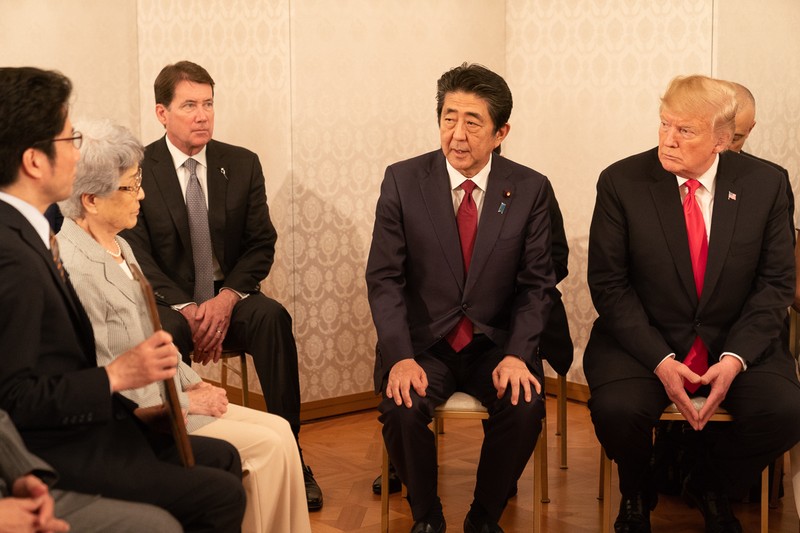
The Japanese prime minister was seated three feet from the president of the United States when he brought up Pearl Harbor.
Sanae Takaichi had come to Washington on Thursday with a careful mission: reaffirm the US-Japan alliance, signal support for the American-led war against Iran, and extract whatever assurances she could about the global economic fallout. She left the Oval Office having been publicly reminded, on camera, that Japan attacked the United States in 1941.
‘Why Didn’t You Tell Me About Pearl Harbor?’
The moment came when a Japanese reporter asked President Donald Trump why the US had not informed allies — Japan included — before launching strikes against Iran on February 28.
“We went in very hard and we didn’t tell anybody about it because we wanted surprise,” Trump said, before turning to Takaichi beside him. “Who knows better about surprise than Japan? OK, why didn’t you tell me about Pearl Harbor?”
Takaichi’s slight smile dropped. Her eyebrows rose. She did not laugh. She did not respond. The room, which included Vice President JD Vance, Secretary of State Marco Rubio, and Defense Secretary Pete Hegseth, went briefly quiet after some initial laughter.
The White House later posted a photo of both leaders giving a thumbs-up.
A Tightrope Over the Strait of Hormuz
The Pearl Harbor quip landed in the middle of what was supposed to be a substantive wartime meeting. Takaichi arrived carrying real commitments: just over an hour before sitting down with Trump, Japan and five European nations — including Britain and France — issued a joint statement pledging to “contribute to appropriate efforts to ensure safe passage through the Strait of Hormuz,” which Iran has effectively closed since hostilities began.
Trump praised Japan for “really stepping up to the plate,” contrasting Tokyo favorably with reluctant NATO members, though he offered no details on what stepping up actually entailed. Japan has not deployed forces to the strait.
Takaichi, for her part, threaded a narrow needle. She condemned “Iran’s actions such as attacking the neighbouring region and also the effective closure of the Strait of Hormuz,” while also delivering an unvarnished economic warning: “The global economy is about to experience a huge hit because of this development.”
It was the diplomatic equivalent of showing up with flowers and a fire extinguisher.
The Alliance Under Strain
The United States and Japan have been formal allies since 1951. In 2016, then-Prime Minister Shinzo Abe stood beside Barack Obama at the USS Arizona Memorial and offered condolences for the more than 2,400 Americans killed on December 7, 1941 — a moment widely seen as closing one of the last symbolic wounds of the Pacific War.
Trump’s off-the-cuff remark reopened it, at least rhetorically, in front of an international press pool. The timing was particularly ill-chosen. Takaichi faces significant domestic opposition to the Iran war, and before departing Tokyo she had promised parliament she would maximize “Japan’s national interest” in her conversations with Trump. Being publicly needled about an 84-year-old military attack — by the ally requesting her help — was unlikely to feature in the briefing she gave lawmakers.
Trump, meanwhile, appeared satisfied with the war’s progress. He claimed the element of surprise in the February 28 strikes had allowed the US to knock out “50 percent of what we — much more than we anticipated doing” in the first two days. The Pentagon has since requested $200 billion in additional funding for ongoing operations. Oil prices have surged to record levels.
“Everything was going great, the economy was great, oil prices were very low,” Trump said. “And I saw what was happening in Iran and I said, ‘I hate to make this excursion, but we have to do it.’”
The Facts Speak Loudly Enough
What the Pearl Harbor comment reveals is not complicated. The president of the United States used a wartime meeting with a key ally — one of the few leaders willing to visit Washington since the strikes began — to crack a joke that reduced an 84-year-old atrocity to a punchline about operational secrecy.
Takaichi sat through it, said nothing, and went on to discuss energy markets. That discipline may say more about the state of the alliance than any joint statement.
Sources
- Trump explains why he kept Japan in the dark on Iran strikes — CBS News
- Trump makes Pearl Harbor joke during meeting with Japanese prime minister — NBC News
- Trump references Pearl Harbor during meeting with Japanese PM on Iran war — Al Jazeera
- Trump Hosts Japan’s Takaichi to Discuss Iran War Support — Foreign Policy
- Japan’s Takaichi Tries to Reaffirm Alliance with Trump as He Seeks Help Securing Strait of Hormuz — Military.com
- Trump invokes Pearl Harbor to defend surprise attack on Iran — Nikkei Asia